Kathmandu- The Gen-Z movement has emerged as a defining chapter in Nepal’s political history, creating tremors across the country’s education sector. The root cause of this uprising lies in the compulsion that forces a large portion of the youth population to seek opportunities abroad. The state’s failure to address youth-related concerns-particularly the inability to ensure job security after graduation-has pushed young Nepalis into deep frustration.
The movement has severely impacted Nepal’s education system. Although political changes introduced new ideas, policies and perspectives in the education sector, the vacuum created after the uprising has led to instability and confusion. As opportunities inside Nepal appear limited, the number of students migrating abroad for higher studies continues to rise. Political instability has drained a significant amount of human capital. The long-discussed “School Education Bill 2080”, introduced after 54 years, has once again been shelved due to the Gen-Z protests.
Following the protests of Bhadra 23-24 and the subsequent dissolution of the House of Representatives, the draft of the School Education Bill-which had reached its final stage after 29 days of teachers’ street protests-became inactive. Along with this bill, more than 30 other parliamentary bills also turned void. The movement caused disruptions in both school and university education, leading to exam postponements and temporary closure of educational institutions.
Education expert Dr. Bidyanath Koirala expressed disappointment over the national tendency to blame and criticize rather than take responsibility. According to him, teachers and professors often avoid accountability even though they play a crucial role in improving academic outcomes. He emphasized that teachers must be committed to students-not political parties-if Nepal is to reform its education system.
Koirala also stressed that universities must create pathways for opportunities alongside education. Referring to the Gen-Z group's use of Discord for leadership selection, he argued that universities could use similar digital tools to explore rural research, innovation and opportunity mapping for students.
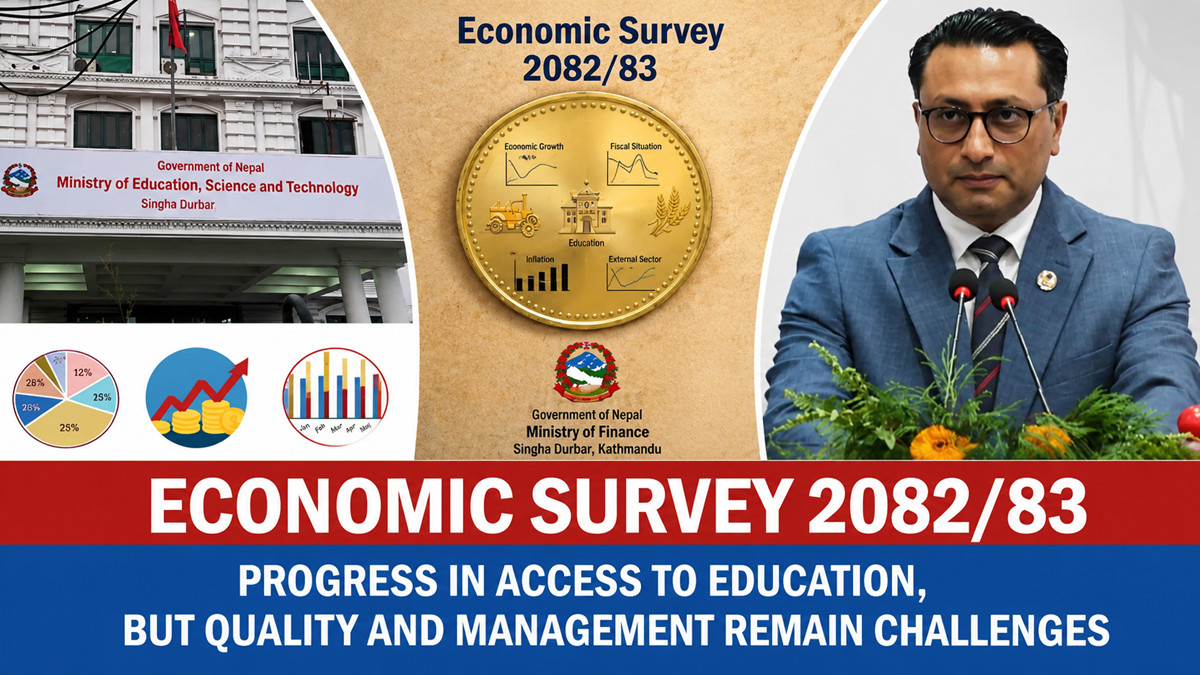
With the formation of the interim government led by Prime Minister Sushila Karki, educationist Mahabir Pun has taken charge as the Minister for Education, Science and Technology. Known for advocating innovation-driven development, Pun’s leadership has raised hopes for a more technical, depoliticized, self-reliant and employment-oriented education system.
After assuming office, Minister Pun introduced several decisions that created optimism:
-
dismissal of teachers and professors involved in political activities,
-
addition of computer-science teaching positions in public schools,
-
making computer studies a full-credit subject,
-
including science and disaster-management modules in schools,
-
investigating land misuse within universities,
-
promoting fair and transparent selection of university vice-chancellors.
Ministry spokesperson Shiv Kumar Sapkota stated that all government bodies have become more alert after the Gen-Z movement. The ministry is working on gradual reforms, aiming to minimize the trend of migrating abroad after Grade 12 by strengthening university education and introducing more technical pathways in school-level education.
Nepal’s education sector has long suffered from policy inconsistencies, political interference, corruption and instability. After the Gen-Z movement, this politicization has intensified. Major political parties have even expressed plans to form student unions inside private schools-raising concerns that schools, colleges and universities may turn into political battlegrounds, further degrading education quality.
Widespread political dissatisfaction, lack of opportunities and deepening distrust have pushed more students to seek education abroad. According to NOC (No Objection Certificate) data, 123,589 Nepali students obtained NOC letters in fiscal year 2081/82, the highest in history. Japan remained the top destination, followed by the UK, Australia, South Korea, the USA and Canada.
Experts say Gen-Z’s growing desire to study abroad is also fueled by global exposure, digital empowerment and the ability to explore opportunities worldwide.
The movement has exposed a national crisis not only in politics but across education-school to university. Politicized student organizations, politically affiliated teachers, unclear educational policies and weak leadership have collectively damaged the foundation of Nepal’s academic future. To restore trust, the government must build a transparent, opportunity-driven and politically neutral education system.